The raised deck
A deck perched above the garden in grooved Douglas boards, on solid posts, with a rope handrail that doesn't block the view. Made for low winter sun and long summer evenings alike.
Timber decks · Dordogne
I build made-to-measure timber decks around Belvès and Monpazier: perched above the garden, covered against the house, or at ground level. Usually in Douglas fir, a home-grown timber that copes outdoors without treatment, with a handrail, a pergola or a swing seat if you fancy one.
What I do
Every deck starts from the ground it sits on: the slope, the sun, the view, and what you plan to do out there.
On a sloping plot or to catch the view: a frame on posts, so the deck sits level with the house rather than at the bottom of the bank.
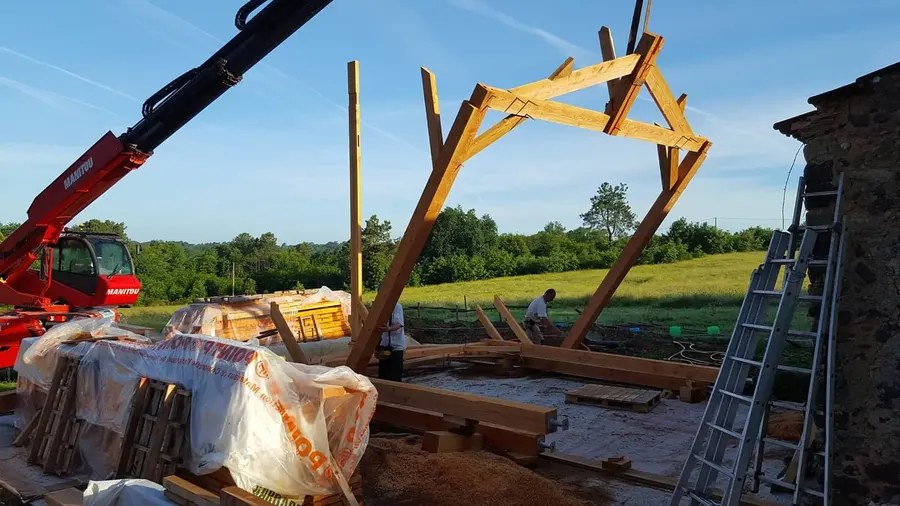
Posts, beams and a proper roof: shade in summer, dry in winter. One side can be closed in with boards to keep the wind off.
The Sunday-lunch deck, flush with the garden or along an old stone wall that holds the day's warmth.
In timber, rope or both, plus the steps down to the garden. Designed for safety, and for the view.
Exposed rafters over the deck, for a vine, a shade sail or a proper tiled roof.
A Douglas swing seat under its own little roof, an armchair made from offcuts: something to make the most of the deck.
Recent decks
A deck perched above the garden in grooved Douglas boards, on solid posts, with a rope handrail that doesn't block the view. Made for low winter sun and long summer evenings alike.
A patch of bare earth against the house. Afterwards: chunky Douglas posts, beams, joists, a roof, and a wall of vertical boards to close off one side. Dry for meals outside, sheltered for the car.
A ground-level deck running right up to an old stone wall. The boards stop against the stone, each one fitted by hand: the kind of detail you only notice when it's done badly.
A Douglas swing seat with its own slatted roof, at the bottom of the garden. A bed of cushions, some shade, and none of the squeak.
The timber
Douglas fir grows in France, it's strong, it has a lovely honey colour and, once the sapwood is cut away, its heartwood copes outdoors without chemical treatment. For a deck in the Dordogne, it's often the best balance of lifespan, price and looks.
But what really makes a deck last is how it's built: the water has to drain away, and the air has to get through.
Common questions
Most of the time I recommend Douglas fir with the sapwood removed: a French timber, strong, that copes outdoors without treatment and stays affordable. We can go for another timber if you have something particular in mind; we'll talk it through with the quote.
It doesn't have to be. Left alone, Douglas turns a lovely silvery grey within a few months. If you'd rather keep its honey colour, give it a coat of oil every so often, usually once a year.
A ground-level deck usually needs nothing, except in a protected area. Once it's raised or covered, it counts as built footprint: a déclaration préalable over 5 m², full planning permission over 20 m² (40 m² in an urban zone under a PLU). The rules vary from one commune to the next, so we check with the mairie, and I'll help you put the drawings together.
Yes, as long as the deck is sound. I put up separate posts and beams, then a roof in tiles, sheeting or open slats for a pergola. One side can be boarded in to keep the wind off, too.
For an average ground-level deck, allow a few days on site. A raised or covered deck needs more structure, so more time. I'll give you a proper timescale with the quote.
What else I do
Contact
Send me a couple of lines and a few photos, by phone, WhatsApp or email. I come round to have a look, then you get a detailed quote. In English or French, whichever suits you.
06 49 75 18 73 Roof frames & roofing
 Extensions, pool houses & shelters
 Insulation
 Tiny houses
 Our work